
Defence Minister Rajnath Singh lauded the armed forces' performance during Operation Sindoor, emphasizing the importance of technology and adaptability in modern warfare. He urged air force commanders to learn from the operation and stay prepared for future challenges.
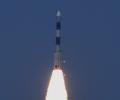
Prime Minister Narendra Modi lauded the scientists saying, "with this successful launch, we will determine our own paths powered by our technology".

India will join an elite group of nations with the launch of a new mission to test re-entry technology, which would be a forerunner to developing reusable vehicles like space shuttles.

'When a Project Director is appointed, the whole organization -- including the Chairman ISRO -- works for his success. It is a lesson that has been of abiding value all through the other projects I have worked on,' recalls the late President, one of the earliest pioneers at ISRO.

ISRO Chairman K Sivan described the GSAT-11 as the "richest space asset" for India.

The two satellites that PSLV will release in the orbit will help the country's mapmakers and amateur radio operators.

'The heat shield technology for re-entry vehicles was first mastered in DRDO for the Agni missile.' 'This is why the Americans were so opposed to Agni in the 1980s, unlike other missiles -- it was a re-entry vehicle.'
Indian Space Research Organisation is using the most powerful configuration of its rocket Polar Satellite Launch Vehicle to launch a communication satellite from Sriharikota on July 15, as it braces for the nearly Rs 200 crore mission.
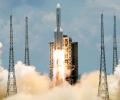
India's first privately developed rocket -- Vikram-S -- is set for launch in a sub-orbital mission with three payloads between November 12 and 16, Hyderabad-based space startup Skyroot Aerospace announced on Tuesday.

Other than the Cartosat-2 series satellite, the PSLV is carrying 29 nano satellites from 14 countries - Austria, Belgium, Chile, Czech Republic, Finland, France, Germany, Italy, Japan, Latvia, Lithuania, Slovakia, the United Kingdom and the United States of America besides a nano satellite from India.
The Indian Space Research Organisation on Wednesday successfully launched seven satellites in 1,200 seconds with the help of its most trusted Polar Satellite Launch Vehicle from the Sriharikota spaceport in Andhra Pradesh coast.The launch was carried out as per schedule at 11.51 am and ended at 12.06 pm.Vice President Hamid Ansari, who was present at the Satish Dhavan Space Centre, congratulated the scientists and technocrats over this splendid achievement for the nation.

Indian Space Research Organisation's (ISRO's) heaviest rocket LVM3 will launch British start-up OneWeb's 36 broadband satellites from the spaceport in Andhra Pradesh's Sriharikota on October 23, marking the launcher's entry into the global commercial launch service market.

Why did ISRO's workhorse Polar Satellite Launch Vehicle rocket fail during its 41st flight?

Docking technology is crucial for sending people and cargo to space stations.
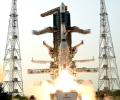
Over 32 missions -- satellites and rockets -- have been planned for the year.

It also carries equipment for meteorological data relay and satellite based search and rescue services being provided by earlier INSAT satellites.
ISRO will launch TechSAR, Israel's first synthetic aperture radar imaging satellite.
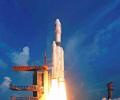
The rocket can put satellites weighing upto four tonnes in space, double the weight that the current GSLV-Mark-II can lift.
In a New Year gift to the nation, the Indian Space Research Organisation on Sunday successfully launched a Geosynchronous Satellite Launch Vehicle with an indigenous cryogenic engine from the spaceport of Satish Dhawan Space Centre in Sriharikota, entering a select club of nations.
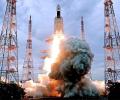
'You can observe a lot of things from space.' 'Another thing is communication, in real time, especially in war-like situations.' 'During Operation Sindoor, we could play our part well.'
The PSLV-C8 rocket will make its first commercial launch with an Italian astronomical satellite on board.

India's ambitious space mission to explore planet Mars would be launched on November 5 from the spaceport of Sriharikota, ISRO announced on Tuesday.
It is scheduled for lift-off at 1658 IST on Thursday from the space port at Satish Dhawan Space Centre at Sriharikota, about 100 km from Chennai.
India's ambitious attempt to flight-test its indigenous cryogenic engine on Thursday received a setback as the homegrown rocket Geosynchronous Satellite Launch Vehicle (GSLV-D3) deviated from path within seconds of lift-off.
For carrying the 360-kg Italian satellite, meant for astronomical studies, Indian Space Department's commercial wing Antrix Corporation would receive a fee from the Italian space agency.

President Pranab Mukherjee on Monday congratulated space agency ISRO for the successful launch of rocket PSLV-C23, saying it is a significant milestone in the progress of the country's space capabilities.
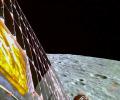
According to the Indian Situational Space Awareness Report for 2023, the nominal lift-off of the Launch Vehicle Mark-3, carrying the Chandrayaan-3 spacecraft, had to be delayed by four seconds based on the Collision on Launch Avoidance analysis.
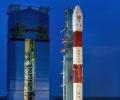
Antrix, ISRO's commercial arm, is eyeing 10% of the $357 billion global market.
Indian Space Research Organisation is all set for the launch of the first flight-testing of indigenous cryogenic engine on homespun rocket, Geosynchronous Satellite Launch Vehicle (GSLV-D3), from the Satish Dhawan Space Centre at Sriharikota at 4.27 pm on Thursday.
The indigenous rocket will carry the second technology experiment satellite GSAT-2.
INSAT-4CR is similar to INSAT-4C, which was lost during the unsuccessful launch last year.

The ISRO had earlier said Chandrayaan-2 will be launched in a window from January-February 16, 2019.Sources said it is expected by the middle of next month but no date has been finalised.
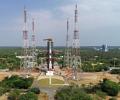
The Aditya-L1 mission carries seven scientific payloads to carry out the study.

After the historic success of its Chandrayaan-3 lunar mission, Indian Space Research Organisation (ISRO) is going full throttle with its plans to send Indian astronauts for the first time to the Moon by 2040, ISRO Chairman S Somanath said.
Greet the scientists on achieving this major milestone!
Indian Space Research Organisation is preparing to launch a geosynchronous satellite launch vehicle (GSLV-D3), powered for the first time by a home-made cryogenic engine, from Sriharikota spaceport this month, its chief K Radhakrishnan said on Friday.
The 51-hour countdown for India's landmark 100th space mission began on Friday with Indian Space Research Organisation's old warhorse Polar Satellite Launch Vehicle rocket all set to soar into space on September 9 with two foreign satellites from the spaceport of Sriharikota in Andhra Pradesh.

The new year will witness two unmanned missions under the "Gaganyaan" project, deep ocean exploration project, "Samudrayaan" and many more.

GSLV Mark-III will be India's most powerful launch vehicle built to lift the heaviest Indian communications satellites to space.
